Tuesday, October 14, 2014

Gabi Part 1 (Northern Chile)


                So I am finally sitting down and beginning my 3 part blog about my trip around South America.  As I am writing this, I am beginning to realize that maybe it took me so long to begin this blog because beginning the blog meant the trip was indeed over, something that has been hard for me to grasp.  You may wonder what or who is “GABI”.  We decided that the trip we were planning was worthy of a name.  The “we” I am speaking of is Felix, Matthias, Sonja and I.  Three of the amazingly crazy Germans that I was able to spend the last year of my life with.   But we couldn’t choose just any name! We needed a name that you could say awesomely… So we chose G-A-B-I!  Planning our trip was not the easiest feat.  First we had to figure out how much time we would have and when we could leave.  Then we had to figure out where as a group we wanted to do.  After that it was a matter of finding plane tickets to the areas we wanted to go.  After that we stopped planning.  We kind of had no real clue of what we were doing but we had the tickets and we would figure it out when we got there….

Day 1:  La Paz to Arica, Chile
The crew and I standing on the Beach with the Pacific Ocean Behind us. "THIS IS GABI"

We loaded up on a bus leaving La Paz heading for Arica in northern Chile.  The bus was to leave the station at 5:30am.  I had barely gotten any sleep the night before.  We were trying to finish cleaning up and packing our stuff since it was our very last night in the house where we lived together the past year.  I may have gotten 2 hours of sleep which was plenty.  I had to say farewell to the rest of the people in the house that were not going on the trip because this would be the last time that I would see them until I go visit in Germany.  I woke them up one by one saying farewell and giving them final hugs.  It was so hard leaving behind the people who were in your life for everyday of the past year.  I hate saying goodbye….
After a nine hour bus ride we finally arrived in Arica, Chile.  Upon arriving, we immediately scheduled our tickets to go to San Pedro de Atacama.  We were not able to get tickets for that day so we had to stay the night.  We went and found a hostel across the street and claimed a room.  Arica is on the Pacific Coast so we made our way down to the beach to watch the sunset as we ate some tomato and spam sandwiches.  It was a great time to reflect on the year that had past and that our time in Bolivia was over.  We all were struggling with the issue that after this trip we would be going home and that our life in South America had run its course.  Once the sun had set, we walked around a bit and sampled some of the fresh juices that they had to offer.

Day 2:  Arica, Chile

                This day was a chill day in Arica.  Our bus was to leave around 8pm, so we had the whole day to enjoy the city.  We finally got up and out of the hostel around 9:30am.  We found a minibus that took us to the other side of the city and made our way up to overlook where the Christ stood above the city.  It was a beautiful view up the coastline and of the city.  We sat up there enjoying our brunch (Sandwiches) and figuring out the plan for the day. We decided to make our way down to an island where we watched the waves crash in and some people managing to surf without hitting the rocks.  Next we walked about 30-45 minutes down the coastline to a nice sandy beach where we chilled in the sun and went swimming a bit out in the pacific.  After swimming we were visited by some random dogs who joined us in digging in the sand. It turned out to be quite amusing. 
Visiting the Christ of Arica

Patrick
Once bored of the beach, we went in search of the market to find some dinner.  We wanted to find something typical of that area.  We stumbled across many stands selling Pailia Marinas.  To me, it is very similar to Clam Chowder.  It was really tasty.  It was a thick substance with clams (in the shells), pieces of fish, some other things, and a crawfish on top.  Next, me and Matthias were still a bit hungry, so we split a ceviche.  We then found a fresh juice stand and then made our way back to the hostel to shower and pack.  We walked to the station and got on a bus headed to Calama and then to San Pedro.
 
Swimming in the Chilly Pacific

Chillin' wit' my DAWGS.

Pailia Marina YUM

Day 3:  San Pedro de Atacama, Chile

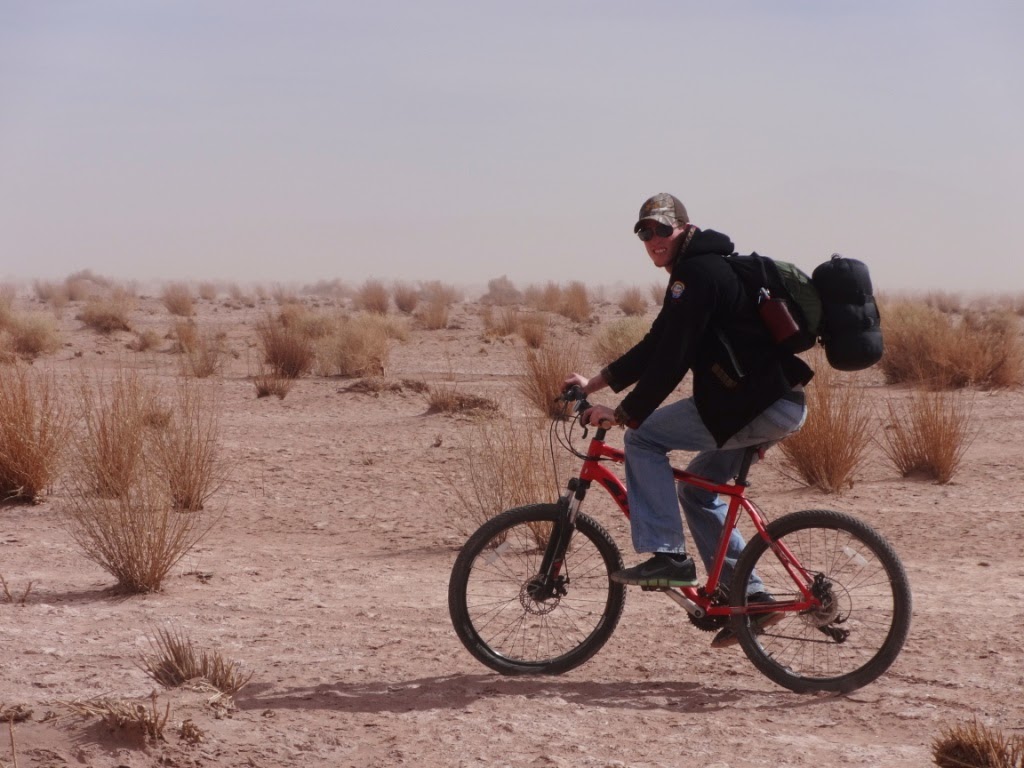
                We arrived to the San Pedro bus terminal in the morning and right away booked our return trip back to Calama because that was where we were to get on the plain for the next portion of our journey after the Atacama.  It’s always important to book your next bus upon arrival if you know when you have to leave because they tend to fill up unexpectedly and also you are already there and don’t have to return to the terminal until it is time to leave.  We then made our way to the city center and began looking for a tour that seemed appealing to book for the Atacama Desert.  The Atacama is one of the world’s highest deserts and is said to be the most arid desert on the Planet.  After searching for a bit we decided that the tours were all too expensive and so were the hostels.  So we rented some bicycles, packed what we thought we needed in our small day packs, and headed off into the desert.  We had a well drawn map (NOT) and we routed our way through the desert towards Laguna Cejar.  Laguna Cejar is a place with 2 small lakes in the middle of the desert.  One lake has flamingos and the other has such a high salt concentration that it is possible to float in the water (like in the dead sea). 
We had a flat tire within 5 minutes of leaving the city.

Beating the Block

Just riding around in the desert....
                We walked around the first lake and saw the flamingos, which was cool but we had already seen so many flamingos earlier in the year in Uyuni.  We actually were not too far from there, just basically across the border (if you don’t count the few hundred miles).  But basically the same thing.  We were walking towards the other lake when we decided to sit down and have a snack which actually ended up turning into a naptime in the desert.  We had nowhere to be.  Nothing but time…  So after napping for about an hour we got up and made our way towards the salty lake.  Felix, Matthias and I got into our bathing suits and took a couple of steps into the water.  IT WAS SO COLD!!!!  No one said it would be cold.  Being men we decided to tough it out and see how far we could wade into the water.  We got about to our knees before we couldn’t take it anymore.  We couldn’t bring ourselves to seeing if we could float of not.  So we snapped some photos and got out and dried off.  We then hoped on our bikes making our way back towards the city looking for a nice place to bed down for the night.  A little ways down the road we found a nice clump of bushes a little ways off the road where we unrolled our sleeping bags and sat down for dinner.  We had bread and cheese and maybe some fruit.  The sunset was one of the most beautiful I had seen up to this point in my life.  After sunset, we got in our sleeping bags behind the bush and slowly drifted off to sleep.  It really got cold once the sun was gone.
Nap Time

Walking on Water

|The View from our Bush

Our Sleeping arrangements

Sunset WOWWWWWWWWWWWW

We be Desert Peoples.

Day 4:  San Pedro de Atacama, Chile

                I woke up a few times in the middle of the night.  Since I was laying on the outside of the group I was getting bombarded by a strong COLD wind that woke me up.  But when I opened my eyes I was greeted by a breathtaking view of the stars.  The Atacama Desert is one of the best places in the world to see the stars.  There were so many of them and they were so clear.  I managed to see many shooting stars.  I also was able to see satellites circling the planet!  Finally I was able to drift back off to sleep but it wasn’t easy with the cold.  I found myself wishing the sun would hurry up and rise.
                Finally we woke up with the sun.  It was amazing to wake up in the middle of a desert.  I was grateful that I didn’t have frostbite on my toes.  With the sunlight things began to warm up and we had breakfast (bread and cheese).  After packing up our sleeping bags, we jumped back on our bikes and started making our way towards San Pedro.  The wind was becoming stronger and stronger as we continued on.  We were peddling against the wind which proved to be extremely difficult because many times it would blow us completely off the road.
  Once in town we decided that we would find a hostel to stay in that night so that we would be close to the bus terminal in the morning and not miss the bus.  We then had some lunch and decided to go to Valle de la Luna with our bikes. It didn’t seem too far on the map.  So, we figured out which direction to go and we started pedaling.  Again we were going against the wind.  We made it to the turn off the main road which made it a bit easier since we were not going against the wind but we did have to deal with extremely strong cross-winds.  Soon, after we started getting pinned down by random sand storms.  It was a little painful in the storms because you were constantly being blasted with sand.  Many times we would have to get off the bike and lay down behind some rocks on the side of the road because it was so bad.  It was crazy because with the air being so dry that as the sand created so much friction on my body that I was being statically charged and every second sparks were shooting out of my fingers into the bicycle.  We finally decided to turn around because even if we made it to the Valle, we wouldn’t be able to see anything with the sandstorms.  Luckily, we had the winds to our backs and barely had to pedal to get back to the town.
Being wind blown.  The wind is actually holding me up..

Day 5: Buses and Planes and problems

                So we woke up early in the morning and made our way down to the bus terminal to catch our bus to Calama.  Once in the airport, we prepared for a day’s worth of flying and airports.  Well we made our first flight from Calama, Chile to Santiago, Chile.  We were just chilling in the airport for a few hours then we were boarding our second flight when we hit our first snag…  As I was boarding, the attendant told me that I was not able to board the flight because I hadn’t paid the tax.  I told him, “ but why can my friends get on and I can’t because they hadn’t paid it either.”  He told me that Americans have to pay a tax to go to Argentina and that I had to go pay the tax but there was no way I was getting on this flight.  I told the others to just go ahead and I’ll meet them in the other airport in Buenos Aires.  “I’ll catch the next one.” I watched them and my luggage take off, leaving me behind.  So I walked around for about 20 minutes looking for the place to pay this tax.  Finally I found it.  It couldn’t cost much I thought but boy was I wrong.  The lady was very helpful though and she let me come behind the desk and fill out everything on the computer to pay my 160 dollar tax.  At least it is good for the next 10 years. 
After getting that payed, she helped me to change my ticket.  But there was a problem with that as well.  The next flight wasn’t for a few hours (around 9:30p) and there was no guarantee I would have a seat.  But there was another option.  I could fly to the other airport in Buenos Aires and the flight would leave in an hour.  Though the problem was that I told the others to wait for me in the other airport and we had no means of communication.  So I asked them if it was possible to send my friends a message to retrieve my luggage and meet me at the other airport.  She said “SURE, we can send them a message that they can receive once they land.” That sounded a little unpromising but I had no other option.  I eventually boarded my plane and began my way to Argentina hoping that the others had gotten the message and that we would be reunited. 
The plane landed in Buenos Aires and I immediately went to find a representative of the airline to see if the others had gotten the message and my luggage.  As she was trying to figure it out, I heard some say Matteo in a slightly confused tone.  It was Matthias! I jumped over the divider and gave him again.  I told him that I thought I’d never see him again.  He told me that they had just gotten there and weren’t expecting me for a few more minutes so he was looking for a McDonalds.  We went back to where Felix and Sonja were and celebrated that after five hours we were reunited again in a totally different country from where we were separated.  I said, “So you guys got my message!”  They looked at me confused because they never got a message.  They had retrieved my luggage in the other airport and asked if they could take it.  A lady told them No.  They explained to her that we were separated, but she wouldn’t give them any information about where I was.  Finally they pried some information from her and she told them that I was going to the other airport.  So it ended up working out, but I was super stressed out.  Since our next flight was early in the morning, we found a quiet corner in the airport and fell asleep.  We were only to awake surrounded by a crew of cleaners buffing the floor around us.  We went and finally boarded our plane heading for Ushuaia, Argentina. 
Reunited in the airport.  

Not so comfortable place to sleep....


Friday, August 29, 2014

Goodbyes Are Never Fun…

           Sorry this blog is so late.....

   Thirteen months ago, I left my family, friends, and home to come to La Paz, Bolivia.  My objective was to work in a foundation helping the poor and the street children.  My goal was to help change lives and to give kids a hope and a future.  I had no clue what the year would hold for me.  So right now I sit in the Lima, Peru airport, waiting on my connecting flight.  After thirteen months, I again have to leave my family, friends, and home to go back to the States.  As I sat in the airplane, watching La Paz and El Alto fade away in the distance, tears began to roll down my face.  My goal was to help change lives, but in the end it was mine that changed.  My world has been rocked.  Now, thinking about the future, I have no clue what this next year will hold for me, nor the years after. 

My Home.  (Photo Credit to Soy Pacena Facebook page)
               
                La Paz has really become my home this past year.  Lately, I have had trouble remembering the day I landed at the airport.  Life before La Paz has become more like a movie.  I remember the events but not so much of how it felt.  What I really feel now, is this life I have gotten accustomed to and how much it hurts to leave it behind.  I am truly excited to go home and see my family and friends, but I am torn apart inside leaving behind all the family and friends I have made here in Bolivia, but most of all the children who have stolen my heart day in and day out.
One of the nights sleeping in an airport during our trip

9 Flights in total on our trip

                I just got back from my trip around South America a week ago (more blogs to come on that) and I have spent the days since telling everyone I could goodbye.  It hasn’t been easy and honestly, I have broken down in tears many times thinking about it.  I was told that the pain you feel and the tears that flow when you leave just show that you truly gave your heart to the people around you.  I must have given most of my heart because it really hurts and there have been many tears.  I waited till the final day before I left to tell everyone at work goodbye, because I knew it would be very difficult.  My first stop was upstairs in the daycare with all the little kids.  They had just gotten done eating lunch and were getting put down for a nap.  A few of them grabbed my hands and telling me “Hi” as we were walking to the napping room.  They all layed down in their little beds and we finally got most of them to sleep.  Standing there watching them sleeping, I remembered the reason I had come to Bolivia.  I stood there with tears running down my face as they lay there snoring with their stuffy little noses.  My next stop was the tutoring program down stairs.  I walked in to visit my little girls who always give me the biggest hugs.  Whenever they run up and squeeze you tight, your heart just melts.  After I told them I was leaving to go back home, they grabbed me by the hand and told me “No te vayas, quedas aqui con nosotros” (don’t go, stay here with us).  Hearing that, my heart just broke in two.  It is so hard to hold back the tears when you here that.

The kids didn't make it easy to leave...

                After saying goodbye to the kids, it was time to say goodbye to the people I had been working with everyday for a year.  I had built so many close relationships with each person on my team, as well as people from other teams.  These people had become like family.  They all felt like brothers, sisters, moms and dads to me.  It was so difficult as we said goodbye.  Eyes filled with tears, I couldn’t walk out the door.  I told everyone that this wouldn’t be goodbye.  It was just a “see you later”, because I am at least definitely coming back to visit.  And those were just the goodbyes from work.  There were so many people who have become a part of my life in La Paz.  Even many of my sales ladies that I have had hours of conversations with down at the market, in the little stores, and at the food stands.

                This past year in Bolivia has been the best year of my life.  I have seen many things that have made me just break down and cry.  I have seen many things that have made me so happy and proud.  I had the opportunity to be a part of many people’s lives and allow them to be a part of mine.  I was able to help many families and children, while having my perspective on the important things in life changed drastically.  I have learned so much while working here.  I was blessed with the opportunity to travel and see many amazing things that I could have only dreamed of.  I know I have lived a lot this past year and that going home is not going to be an easy task.  It will take a lot of adjusting to get back in the swing of things but I never want to be like I was before.  I want to hold on to the things I have learned here in Bolivia and I want to put them in to practice once back.  I want to share the things I saw and the things I felt.  I want people to know my Bolivia.  No matter what I do in the future or where I am in the world, Bolivia and all those people will always be in my heart and I will never forget the best year of my life.

Monday, July 7, 2014

Las Yungas

The Yungas
So I finally made it Coroico.  It is only 3 hours from La Paz but I’ve never been.  I have seen it twice but only from a distance off through the valleys.  Once after I did the Death Road on bicycle and once after we finished our three day hike of the Choro Trail.  I have always heard many things about this small city because it is a common vacation point for many people who live in and around the city of La Paz.  But now it was my chance to go and visit for a few days.  Like I said it is only a 3 hour minibus ride away.  It takes the same route as the beginning of the death road.  You cross up and over the Cordilla Real and then wind your way down through the mountains before entering into the lush green hills and valleys of the Yungas.  It is a very beautiful ride watching the black snow covered mountains transition into tropical green vegetation.
 
Coroico
                Once arriving in Coroico it was a bit cloudy and colder than I would have imagined.  Apparently a cold front was moving up through the valleys from Santa Cruz and bringing a bit of rain.   But since it was in the evening it was a good time to relax and get settled in.  I stayed at Hostel Sol and Luna, which is situated high above the main square of Coroico on the mountain side.  It is a very beautiful and peaceful place to spend a few days.  There were hammocks to lie around in and a nice restaurant to grab a bite to eat.  It is only about a 15-20 minute walk up from the main square.  It is surrounded by trees and tropical plants.  Also there are plenty of birds that will sing you a tune no matter what time of the night it is…

                The following day I went on a tour of a coffee plantation.  I have always wanted to see one and figure out where that addictive coffee bean comes from and how they turn it into that liquid gold.  The coffee plantation was owned by a Swiss guy.  So it was pretty orderly and you could be sure quality was a factor just like all products from Switzerland.  The tour started off talking about the different kinds of coffee plants.  I never knew that they needed shade trees over them to keep them from getting too much sun.  Coffee trees can come in different sizes and shapes and also have different color berries, but all the coffee beans look the same.  After explaining about how they grow the bean it was time to see what they do with it after they harvest it.  This was a pretty interesting process.  They had a hand cranked machine that peels the fruit off of the coffee bean and spits out the beans into a bucket.  The fruit of the coffee bean is not wasted.  It is dried and bagged and sold as well to make a special tea called Suntana.  This tea is used to help lower your blood pressure and has other good antioxidants.  After the bean has been removed, they wash it off and then spread them out to dry.  A couple of days later it is put into a greenhouse to continue the drying process.  Once it has reached 10% humidity in the bean it can be bagged and stored.  When it is time to sell the coffee they take the beans out of the bag and roast them.  Then the beans are packaged and shipped out the following day.  Once roasted a coffee bean holds its flavor for about 3 months.  After it has been ground it only holds its flavor for about 1 month.  After the tour, was a small taste testing of coffee which continued to blow my mind.  I had always been so curious about how coffee was produced and after this tour I just wanted to stay and work on the plantation for a while.
 
Coffee Beans growing on a tree
                Later on in the main plaza I met a tour guide.  He was willing to give me a good deal on some tours, so I asked him what was available.  One tour really stood out to me.  It was touring one of the black villages nearby named Tocaña and getting a little background and history on the culture.  You may remember from my previous blog that many Africans were brought to Potosi as slaves working in the mines and coin mint.  After they were freed from slavery many moved to the Yungas and started small villages because it had a nicer climate.  So I talked it over with him and we planned the trip for the next morning. 

                So the next morning came around and Rolando came to pick me up from my hostel.  I walked with him down to Coroico.  It was a nice walk because he was explaining to me things about the city that I hadn’t known.  We then got a taxi that took us down the mountain, across the river, and up to one of his friends’ house that was a researcher.  He showed us a documentary about how the people came to the village and about how life was and is for them.  I thoroughly enjoyed it.  We then walked up the road and veered off onto a path that took us through countless orange, banana, tangerine, and grapefruit trees.  We came to a small clearing where there were a few houses and a yard.  In the center of the yard was a large tarp where they were drying coca leaves.  There were also more fruit trees surrounding the yard as well as cocoa trees for making chocolate.  I was seeing some things I had never seen before in my life.  Sitting on the porch was an old man and lady with a young girl about 3 years old.  We sat there and talked to them for a bit before continuing up the path.  We next passed a house where a lady and her little daughter were hanging up laundry in the yard.  Apparently Rolando knew the lady because they talked for a bit and Rolando was saying how big the little girl had gotten.  I could really tell how enthusiastic Rolando was about this community and that he cared about them deeply.  He knew many of the people that we met and I was so grateful to have a tour from someone who was passionate about what he was doing.  It didn’t feel as if I was walking around with a tour guide but more like I was walking around with a friend.
               
Rolando's Friend's house

Path through the jungle

Drying Coca Leaves

One of the houses

Tangerines

View from Tocana looking back at Coroico

Main road (Only Road) through the village

Me Chilling by the river


                We continued walking and went through the center of the town.  It wasn’t that big just a dirt road with a few buildings and a couple of houses.  We then hopped back into the taxi and made our way down the road.  We stopped first at a coca plantation and then down by the river called Coroico.  It was such a beautiful place.  I just sat there on the bridge for a while watching the water run by and enjoying the warm sun.  Then we rode back up to the city.  Afterwards, I walked back up to the hostel and just chillaxed in a hammock enjoy the weather trying to figure out what excuse I could use to stay for a few days longer…  I can say that I fell in love with this part of the country.  I would love to move to Coroico for a while and work in the villages nearby in the Yungas.  I think it would be great working to help with education and planning in the villages and also building some things.  I believe that I would truly enjoy doing that.  Also maybe working on that coffee plantation…
Chillaxin'

Silver Fever

               
Cerro Rico over my left shoulder
A couple of weeks ago, I took a little trip to learn more about some of Bolivia’s past.  My first stop was in the city of Potosi.  Potosi, founded in 1545, was once one of the wealthiest and largest cities in the world.  It all started once silver was discovered in a mountain (Cerro Rico).  It is said that a man was on the mountain and made a fire to keep warm.  After the fire had gotten so hot, a shiny liquid began to flow from under the fire.  Afterwards, the Spanish came to exploit the mountain for the shiny metal.  This city prospered greatly as did the Spanish with every ship load of silver that arrived in its harbors from Potosi.  The city continued to grow and the mines as well. They brought in African slaves to work in the mines.  Many did not last a year in the mines because of the horrible conditions, many that still remain today.  But as all good things, they must come to an end.  After the collapse of the silver market, many left Potosi and the city lost its wealth.  The Africans that were brought over to work, left the cold high altitudes of Potosi and made their ways to the Yungas near Coroico to be in a more tropical climate.  For those who stayed in Potosi, life was a struggle and many stilled mined silver and tin to try to make a buck.  The mines in Potosi have been and continue producing silver since the 1500’s.
 
View of Potosi from above
                Potosi is a descent sized colonial city in the southern part of Bolivia and also ranks as one of the highest cities at 13,420ft above sea level.  Upon arriving at the bus terminal, I commandeered a taxi that took me to the main plaza.  It was around 7 in the morning and extremely cold.  I walked around a bit shopping for a nice cheap hostel that I could spend a couple nights.  Finally I was able to find one and I quickly made my way to my room and jumped under the covers to get warm.  I decided it was best to take a little nap before I started my day off.  After my rest, I took a shower and made my way out into the city to figure out what I was going to do the next couple days.  My first plan was to schedule my trip to the silver mines which was the main reason I wanted to stop in Potosi.  So I found a place and scheduled a visit for the next morning.  I then asked for a few suggestions of things to do.  They suggested two convents and the casa de móneras.  Since the Casa de Móneras is closed on Mondays, I decided to go to visit the convents.  The first convent I went to was the Convento de Santa Teresa.  Here in this convent, families would give their second daughter to God.  The girls would leave there families to live in this community where they would learn to serve God and never see the outside world again.  They would make crafts and other things to sell to the people on the outside to support the convent.  It was a very beautiful and interesting place.  I could never imagine entering this place and never again to see the outside world or my family again.  Even after they died they were buried underneath the floor of the convent. 
 
View from the roof of Convento San Francisco
                After the tour I decided it was lunchtime and I went to find me a place to eat a bit of lunch and watch some of the World Cup.  In the evening I went to visit the Convento de San Fransisco.  I was able to take photos in this convent.  The tour was more focused on the art of the convent.  After viewing a bunch of paintings and sculptures, we made our way into the sanctuary which was very beautiful.  Next we went down a small locked staircase to the catacombs underneath the sanctuary.  Underneath people would be put into a room for a few weeks until their meat was dried and coming off.  Then the remainder would be peeled off the bones.  The bones from the dead would then be put into a box and stored underneath the sanctuary so they would have a more direct path to heaven.  Most of the bodies were taken out of the catacombs and buried in the cemetery by orders of a president because the smell was becoming very strong in the sanctuary.  A few skeletons still remain as reminders of the history in the convent.  Afterwards, we climbed the spiral staircase to the roof of the convent where we had an amazing view of the city and Cerro Rico. 
 
Inside Convento San Francisco

The Altar in San Francisco 
Where they left the bodies to rot off their meat...

Some Leftover bones and skulls

The next morning I made my way to the agency where I had scheduled my trip to the mines.  The first stop we made was the miners market.  Normally, people buy gifts to take to the miners in the mines because it is still an active mine.  Kind of a way to show them respect which opens them up to talking about their job and life.  In the market I bought them a 2-liter of Coca-Cola, some Coca leaves, and some dynamite with a bag of nitroglycerin.  I was pretty surprised at how cheap the dynamite was and shocked that it is legal to buy here for anyone.  We then made our way winding up the mountain to the entrance of the mine.  The workers are very superstitious when it comes to the mines.  Outside of the mine belongs to God, but below the surface belongs to the Devil.  They call him “Tio” which means uncle.  If they appease the devil than he won’t mind if they take his silver and he want allow a collapse of the mines.  At the entrance to the mine, they sprinkle Llamas blood as a sacrifice for safe passage.  Once in the mine, there is a statue of Tio where the miners give him alcohol, cigarettes, and coca leaves to show him respect.  Also another superstition they have is that women can’t enter the mines.  The reason is that Pachamama (mother earth) will get jealous of a woman if she comes into the mines to work and that it can cause all sorts of problems.
 
Yea I bought some Dynamite!

El |Tio (Devil)

Once in the mines, things begin to get crazy.  The main tunnel into the mine is where the workers push the heavy carts in and out of the mine on tracks, hauling the precious ore or debris out of the mine.  It is extremely hard to stop a full cart, so if you are in the tunnel and see or hear a cart coming you have to run as quick as possible to find a place to get over to the side and out of the way.  It is an adrenaline rush when you know you have to hurry to find a safe place.  After dodging a few carts, we stopped to see Tio and give him some sacrifices.  We then made our way deeper into the mines to find some miners at work.  In the tunnels of the mines are many places where there are drop-offs up to 100ft down into the mountain.  So you have to carefully make your way through the tunnels where we encountered our first set of miners.  We were able to talk with them a bit and learn about their work in the mines.  We gave them some gifts and made our way deeper into the mines.  In order to reach the next group of miners, we had to get down on our stomachs to crawl through some small passageways.  Once we reached the miners, we had the opportunity to do some work.  I quickly volunteered.  I made my way back into their work area and began shoveling silver ore and debris down into a cavern below.  It was hard work but I enjoyed.  I could have stayed there the whole day and worked with them.  I truly enjoyed it.  Then we made our way to another worker who was above us and preparing to chip away in the caves above.  To reach him we had to crawl through more small tunnels and up through switch backs climbing up to where he was.  It wasn’t the safest of passageways but we made it up there.  We talked to the miner a bit then I helped him assemble his chipping machine.  Noticing what time it was we had to make our way out quickly because many people were detonating dynamite at 1 and we only had a few minutes to get out.  So we said farewell and quickly made our way back through the tunnels.  Once we finally made it to the main tunnel, we ran dodging many carts full of ore on the way out.  Finally, we saw day light and made our way out of the mines. 
 
Chilling in the Dark

Doing a Lil' bit of work (Notice all the dust flying around)

Chilling by the Carts

I had an amazing time in the mines and really could have spent the whole day down there.  But, the reality is that these mines are very dangerous.  Many people enter these mines everyday because there is no other option of work in the city.  Many start at young ages of 15 or sometimes less.  Many miners, unless they take care of themselves and are cautious, don’t live more than 15 years after entering the mines.  The mines employ around 15,000 workers.  The mines have claimed up to 8 million men since the discovery of silver.  The men who don’t die in the mines usually suffer and die from extreme cases of Silicosis from the dust and toxins they inhale day-in and day-out.  The conditions in the mines are rarely improved.  The mountain has become known as “The Mountain that eats men”.  If the mountain doesn’t get you the silicosis will.  In reality, once you begin working in the mines, you have signed your death sentence.  It is a tragedy that this is the only option for many young men.


After we had left the mines and made our way back to the city, I went over to the Casa de las Moneras to take a tour of the Spanish mint.  The Spanish empire ordered that a mint be built in Potosi to coin silver for the empire.  Once the king received the bill for the mint, his remarks were, “that mint must be made out of Silver”.  In this mint millions of coins were minted from the silver ore that was extracted from the mountain.  Many slaves from Africa and indigenous from Bolivia were forced to work in the mint.  There were many harsh conditions that went along with the work there.  In the mint were 3 large machines that were used to flatten and cut coins out of silver.  At first they were powered by 4 mules below that would turn a post that gave force to the machines.  Since the mules would die after a few months from all the work, 20 African slaves were used to turn each machine because they lived longer.  The history of this city that built the Spanish Empire is a long and sad past.
Mule powered Machines from inside the Mint
Some cool looking Scales
This place was built like a fort
The next day I went back to the bus terminal and quickly caught a bus to Sucre which is only 3 hours away.  Sucre is the real Capital of Bolivia and has been known by many names.  The names before were Charcas, La Plata, and Chuquisaca.  It now is also known as the White City because all the buildings in the city are white and it is illegal to paint them any other color.  It is a very beautiful city to relax in and enjoy the colonial architecture and narrow streets.  Since Sucre is at a lower elevation of 9, 220ft, it has a warmer climate than Potosi.  This appealed to many of the royal and wealthy families from Spain who were in the silver trade.  Many Spanish lived here as well as a prince who built a traditional castle near the city.  It was a pretty happen place which is why it became the Constitutional Capital of Bolivia.  Now it is only the seat of the Judiciary branch of the government because the President Evo Morales, wants to move everything to La Paz.  But that’s a long story I don’t want to get into…
 
Municipal  Building from the center
 Once in Sucre I quickly met a guy who took me to his hostel.  It was a pretty decent place with a nice Villa on top with couches and a huge TV as well as a great view of the city skyline.  I dropped my things in my room and showered before making my way down to the market to grab a late lunch.  As soon as I found the comedor of the market I sat down at a table and the lady brought me a plate of food.  It was amazing.  I sat there for a little while talking to a couple gringos and then made my way towards the city center to walk around a bit.  There is a large beautiful plaza in the center of the city.  It is like a small park with fountains and may large trees with park benches underneath.  It is an amazing place to relax and watch the busy people around you go about their days.  Afterwards, I walked around the city a bit more exploring looking for interesting things to do.  There isn’t much but there are a few things outside the city to do if you wanted to do a day trip.  I spent the evening relaxing and went to eat a nice filet mignon in a French restaurant before turning in for the night. 
 
View from my Hostel. (Notice all the White)
The city lights up at night!
The following morning I set out from my hostel to see if I could discover how to get to the overlook above the city before lunchtime.  I walked a few streets climbing the hills towards where I thought it should be.  After about an hour, I discovered a plaza high up on a hill with a church/museum on one side and a beautiful overlook on the other.  It was an amazing view of the city as you could see the white buildings with red tile roofs and narrow roads all throughout the city.  I winded my way back through the city towards the market to eat a plate of Mondongo, a famous plate that the region is known for.  It consists of a piece of pork cooked with red aji and yellow corn.  It was good but I’m sure there are better ones around the city.  Afterwards, I went back to the hostel to rest and watch some more of the World Cup.  In the evening I waited for my friend that I had met in Uyuni to pick me up.  She lives in Sucre so I figured she would be a great candidate to hangout with and learn more about the city.  The first place she took me was to the dinosaur park on the outskirts of town.  Years ago when they were clearing land for their cement production factory they were using dynamite.  On one mountain, the dynamite blew and a slab of the mountain slid down revealing hundreds of dinosaur footprints.  Apparently, millions of years ago, where Sucre is, use to be a lake and many dinosaurs trekked through the mud leaving their footprints.  With the seismic activity, the lake dried up and the muddy footprints were pushed up into a mountain.  It is pretty interesting and the people of Sucre are pretty proud of their dinosaurs and their park.
 
Beautiful Overlook for the city

Footprints of Dinosaurs

T-Rex trying to sneak up on me

Sun Setting over Sucre

After touring the park she took me on a tour around the city showing me the sights and the countryside.  It was really nice just to ride around and see the city.  Next we walked around the city seeing it lit up at night and we went to a park that I hadn’t been to yet.  It is called Parque Bolivar.  We were lucky because upon arriving, there were many college students practicing many traditional dances for a parade that they would be having a few days later.  So we just sat there and watched the band playing and the people dancing for about 30 minutes.  It was pretty awesome to watch.  Finally, we walked around the park which was cool because the whole park has a Paris theme except for the kids’ park right next to it which has a dinosaur theme of course.  We then went down to the central market to have buñuelos and tojori.  This is a traditional thing for many people to do in Sucre in the evening.  Buñuelos are kind of like a funnel cake and Tojori is a corn drink and they are both very tasty.  I could get use to having it every evening. 
 
From Parque Bolivar ( I think it is the Eiffel Tower?)

The main path through the park

Judiciary building overlooking the Park 


The next day I decided should be a restful day.  So I packed my things and then went to the bus station to buy my ticket to return to La Paz.  I then went back to my hostel and talked to the manager for a bit before walking down to the market to have some chorizos for lunch.  Afterwards I returned to the hostel and went up to the villa on top to kick back and watch some of the World Cup and relax drinking some Mate.  Later that evening I went back to the market to again eat Buñuelos and drink some Tojori before heading to the bus terminal.  I couldn’t think of a better way to end my vacation!